

Interview with Miguel Díaz-Canel
By Jorge Lefevre Tavárez and Luis de Jesús Reyes, CLARIDAD
Fotos Alina Luciano Reyes
When CLARIDAD originally conceived the possibility of interviewing Miguel Díaz-Canel, President of the Republic of Cuba and First Secretary of the Council of Ministers of the Communist Party, the full force of the renewed imperialist aggression of Donald Trump’s second presidency had not yet manifested itself. The invasion of Venezuela had not occurred, nor the war with Iran, nor the tightening of the blockade against Cuba through an energy blockade, which has halted the arrival of fuel to the country and completely paralyzed its economy. When the request for the interview was accepted, the immediate political circumstances largely guided its course: the preparation, the trip, the questions.
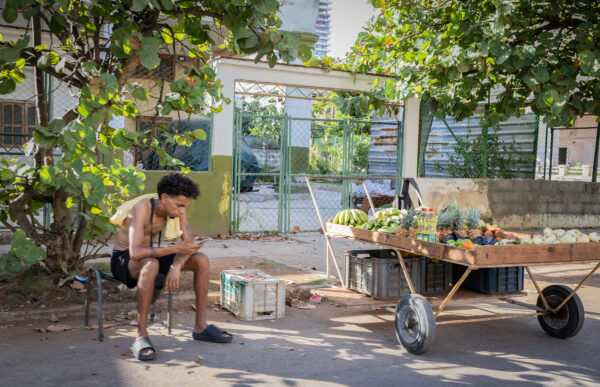
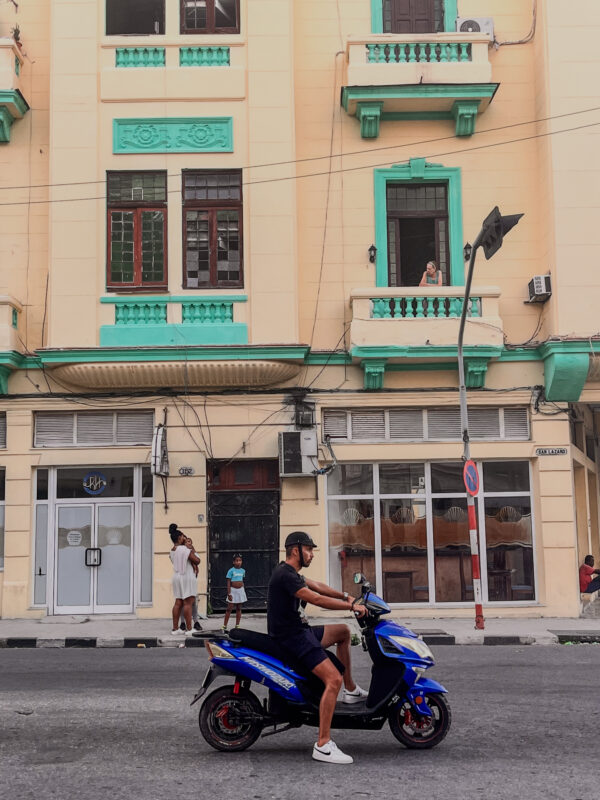
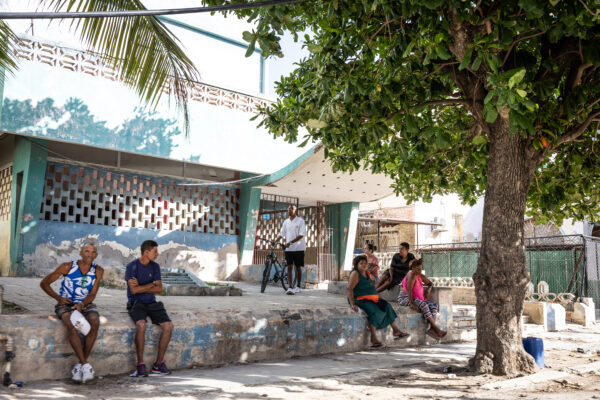
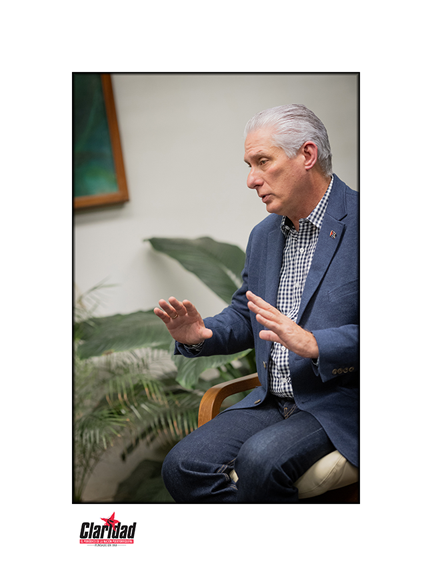
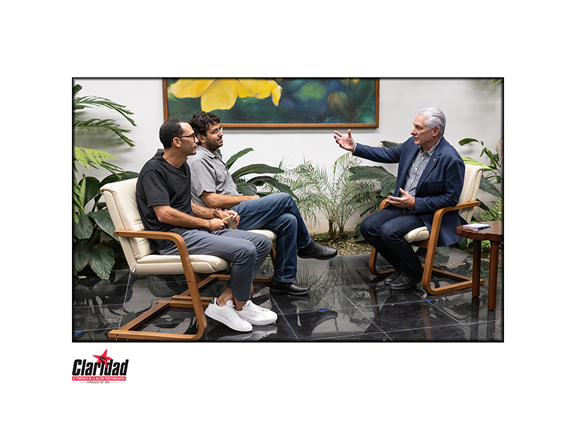
The Havana that welcomed us was different from the one previously known: of power and water cuts due to the precarious situation, a garbage crisis, but also signs of a response to the situation: electric motorcycles and tricycles, communities self-organizing to clean their common spaces. The interview took place at the Palace of the Revolution, the seat of the Presidency and the Government, with its wide spaces, its paintings referencing the history of the Cuban Revolution, and an indoor garden, originally designed by Celia Sánchez to simulate the vegetation of the Sierra Maestra.
Participating from the CLARIDAD team were Alida Millán Ferrer, Director of Claridad; Jorge Lefevre Tavárez, alternate director of En Rojo; Luis de Jesús, Puerto Rican journalist residing in Cuba and correspondent for Claridad; Alina Luciano Reyes, head of photography for CLARIDAD; with contributions from Mauro González on video. To this is added the constant support in all facets of the trip and this interview from Edwin González Vázquez, of the Puerto Rican Mission in Cuba.
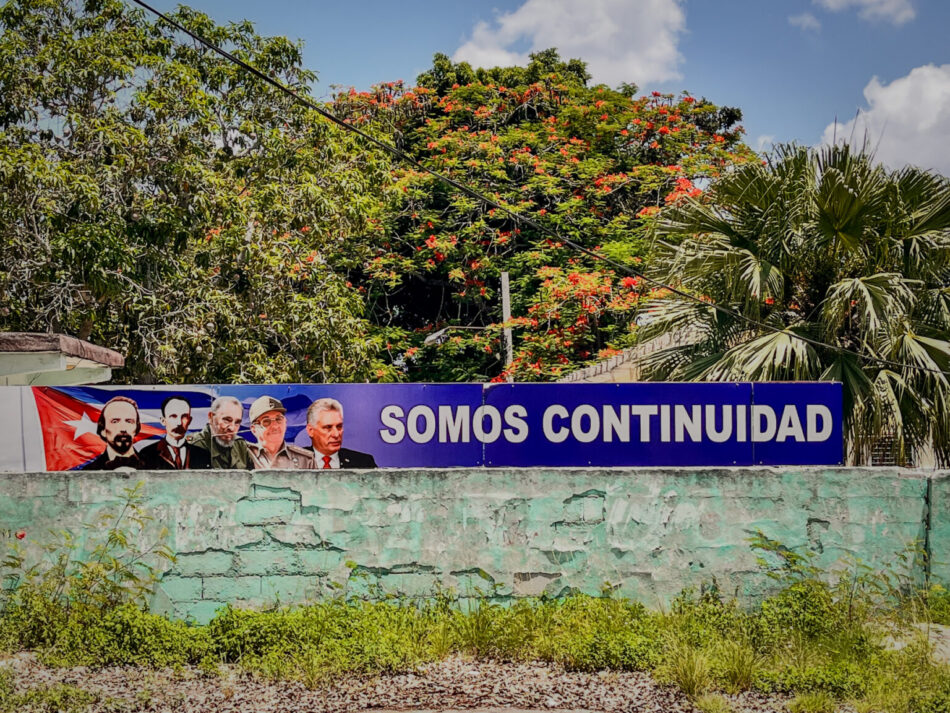
Jorge Lefevre Tavárez (JLT): On behalf of the Claridad team, we want to thank you for this opportunity, Mr. President Miguel Díaz-Canel…
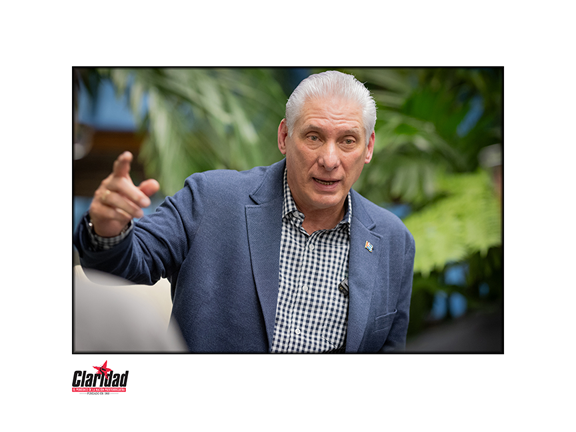
Miguel Díaz-Canel (MDC): First, do not call me Mr. President, I am no “Mister”; I am your compañero (comrade).
JLT: In recent weeks, certain issues have caused great interest and raised big questions about what is happening in Cuba, within the context of an intensification of imperialist aggression by Donald Trump’s presidency. We wanted to start the conversation by discussing the 176 economic and social measures that were recently announced. From different ideological perspectives, a question has arisen: what could happen in the future, as a result of these measures, which open certain strategic sectors for Cuban socialism to private capital and the market? To give two examples of these, there is an opening to private banking, and the flexibilization of real estate sales. We wanted to know, then, your opinion on these concerns and on a possible opening to capitalism in Cuba.
MDC: I think it is unfair when they indicate that these measures, which we are applying sovereignly and which have been built with a certain consensus and through discussion over many years, have anything to do with a capitalist restoration. As part of the natural process of generational continuity in Cuba, the generation that is currently assuming the main responsibilities in the Communist Party and in the government, in the state, was born with the Revolution, and we defend the Revolution. The Revolution is our life. It cannot be thought that any of us is promoting a capitalist restoration in Cuba.
But whenever something is done in Cuba, everything is controversial; it always arouses interest. The Cuban reality is also manipulated, and attempts are made to give it many interpretations from the right and, unfortunately, sometimes from the left as well.
First, we have a challenge as a nation, we have a challenge as a Revolution, and it is a challenge that we must assume with great responsibility and objectivity. Cuba is trying to carry out the process of socialist construction, and I insist, of socialist construction under the conditions of a small island that has survived the economic, commercial, and financial blockade, intensified and now taken to the utmost extreme with an energy blockade, by the most powerful power in the world. How do you build socialism under these conditions? Did anyone conceive it? Was anyone able to advance it?
We have studied Marxist theory. We have also studied the Russian Revolution, the revolutionary movements of the world, and the experience of socialist construction in Vietnam and China. But no one has been subjected to the prolonged blockade that Cuba has had. Who can teach us how socialism is built under these conditions if no one has that experience, if no one has lived it that way? That is why we have gone to the essence of our history, and to the essence of Fidel’s thought, of the Army General’s (Raúl Castro), and to the legacy of Che’s thought.
This debate has already been going on for several years. Although there are people who say that these are new measures, since the Sixth Party Congress, when the first version of the Guidelines of the Economic and Social Policy came out, it was already stated that changes had to be made to our economic and social model without renouncing socialism. Subsequently, in the Seventh and Eighth Congresses, the economic and social model was conceptualized.
In the process of construction, or, as it is called, the transition to socialism, there are different types of property. What distinguishes socialism is that social property is the fundamental one, over the main means of production. We have not denied that. On the other hand, in our Constitution, which is a socialist constitution, different types of property are recognized, as well as how to manage even the social property of the entire people by different economic actors.
We are living through an extremely complex blockade situation, with accumulated economic and social damage due to its prolonged nature. We must be able to build that socialism with Cuban characteristics. Therefore, it is about not renouncing the ideal and advancing, without denying the socialist construction. Because we have never been able to build the socialism we want, but the one we have been able to build.
It strongly catches my attention that this program of measures has many aspects and much content, yet people focus heavily on whether we are opening up to the private sector in certain activities. Why don’t they see that the first thing they do is declare the continuity of socialism in Cuba? Why don’t they see that we continue to ratify social property as the main form of property? Why don’t they say that all we are trying to do is unleash the productive forces to build more in the midst of these conditions, to produce more material wealth, and distribute it with social justice? Any measure we apply always looks toward people who are in a vulnerable or unequal situation. Those are socialist concepts that will be prioritized in everything we do.
But, furthermore, most of the people who represent the, let’s say, non-state or private sector in Cuba, are revolutionary people. They are not people who oppose the Revolution. When we are talking about the possibility of Cubans residing abroad investing, we are not talking about Cubans who want the Revolution to disappear; we are talking about Cubans who have maintained a relationship with their country, a relationship with their identity, who want to contribute. It would be contradictory if we, who are open to foreign investment, did not also open ourselves to investment by Cubans who reside here or abroad. These are elements contained in this measure. And there are historical precedents.
Remember that Cuba has never had it easy as a Revolution. In ’62 we were in a crisis, on the brink of a worldwide nuclear conflict. Later, in the nineties, the Special Period arrived. In the Special Period, what is now seen as entirely normal was innovative and necessary at the time. At that time, for the first time, Cuba decriminalized foreign currency, and decriminalizing foreign currency already meant creating certain levels of inequality in a society that had always fought for social justice. It meant that a group of people would distinguish themselves from others, not because of the contribution of their work, which is the principle of distribution in socialism, but because they had the possibility of receiving remittances.
But the country needed foreign currency. That currency wasn’t entering because it was blockaded; if it could enter that way, why would we deny it?
Things in political economy must be seen in all their interrelations. Cuba takes that step to have a level of foreign currency available. But what is Cuba going to use that foreign currency for? To strengthen social programs, to strengthen the economy, and by strengthening the economy, to be able to sustain social programs. Our vision, which Fidel taught us, is economic development, but with social growth. Capitalist countries develop economically, but there is no social development because there is no social justice. All of that has been part of this debate.
Rest assured that there is no betrayal of socialist construction here, neither by principle nor conviction nor action. Here we are going to continue defending socialism, and we are going to continue defending social justice. But we need to unleash the productive forces so that the country creates more wealth, and by creating more wealth, we can sustain the conquests of the Revolution… That is a merit of the Cuban Revolution: through so many years of the blockade, we have maintained social conquests such as education and health, with universal, high-quality, free systems accessible to all. There are countries that have a great deal of wealth and haven’t even managed to have that.

Luis De Jesús (LDJ): Many of these measures had even been proposed by Cuban economists and Cuban experts for several years. You even mentioned that they had already been discussed in previous party congresses. The question that remains now is: why, with the speed and immediacy that have been achieved now?
MDC: Because of understanding. One cannot apply measures if there is no understanding, if a consensus has not been built. Notice that even so, in the midst of this situation, we are proposing them, and there are divided opinions. I depend a lot on what we politically ensure regarding the understanding of these measures. These are measures that carry contradictions, that carry risks.
Not all economists have always proposed them from the perspective of socialist construction. Already, there is a group of economists out there saying that there is a project for a social market economy – they removed the word socialism. Others have begun to say that changes must be made to the political system. We are not going to make changes to the political system. We continue to defend our socialism.
That was a debate, as I was telling you, since the Sixth Congress. It was enriched in the Seventh, advanced in the Eighth, and we were already preparing for the Ninth Congress. At the end of last year, when we were preparing to take all these things to the Ninth Congress, we had to postpone it because the country’s situation was very complex and we had to focus on the fundamentals.
But what did we explain at the 11th Plenum of the Central Committee of the Party, held at the end of last year? The postponement of the congress did not mean we would not implement what was necessary to ensure continuity of the Revolution.
Undoubtedly, the situation is also giving us a sense of urgency. Not a drop of fuel has entered here for six months. Can any economy in the world function without fuel? Can any economy in the world maintain social programs and social justice without fuel? A genocidal, criminal policy has been applied to us. What is being committed against Cuba is a crime. And amid these conditions, we continue to dream and to defend our principles. But there are things that must change.


LDJ: Regarding the conversation or communication that must be had with the people, so they understand these measures. President, I have been living here for five years, and recently scenarios not seen four years ago are emerging. For example, on my block, there are cacerolazos (pot-banging protests) practically every night due to discontent with the blackouts. Do you think the population really understands the situation they are in?
MDC: I think the majority does. We cannot be idealistic; sometimes Cuba is also viewed with tremendous idealism, and it is believed that in a process of socialist construction, facing American aggression, everyone will think alike and act alike. That is impossible. The thing is that they only pin these peculiarities on Cuba in the media intoxication used to discredit us. This is also a heterogeneous society, like any society in the world. But it is a society with political maturity. I will tell you that most of our people know the cause of our problems, and they know that rather than poor management—as the spokespersons of imperialism try to blame us for (because they know the will with which people work here, they know the link that exists with the people and how problems are addressed)—the main obstacle to our development is the prolonged blockade and the tightening of that blockade.
But that alone does not satisfy them. That conviction alone, resistance alone, does not solve the problem. That is why I said in the National Assembly and in the last plenum of the Central Committee, that a revolutionary government, a revolutionary party aware of the situation is not there just to explain the crisis, it is there to help solve the crisis.
Things must be done, and we cannot remain frozen in time. I tell you, in the midst of all that situation, which you have lived through, which is harsh, because here there are shortages of transportation, of food, of medicines, here there are prolonged blackouts of more than twenty hours, which causes dissatisfaction; no one can be happy, the people are suffering. It is part of the imperialist strategy. The imperialist strategy is to economically asphyxiate us to provoke just that: a rupture between the people and the revolution. As Trump said one day, “We have applied all possible pressures to them; there is almost nothing left to apply other than wiping them out.”
And why haven’t they achieved the social explosion? Why haven’t they achieved the rupture?

People bang pots, some with more disgust than others. I say: well, bang the pots for the neighbors to the north, who are the ones keeping us in this blackout.
There are all those realities. As I say, it is the Cuban color, the nuances in the way of acting and feeling things, too. These are not issues to be seen in black and white; they involve many situations, many reasons. But look, I have the conviction that we are going to overcome this, and that we are going to move forward, and that we are going to win, and that we are not going to surrender. We will not surrender.
JLT: When you assumed the presidency, there was still some optimism due to the dialogue that had been resumed with the United States, which, although it never eliminated the blockade, established some communication and yielded economic fruits. Now, even though Cuba has repeatedly shown its interest in dialogue, there is no longer just a resistance to dialogue, but a total offensive in this second presidency of Donald Trump. First, we would like to know whether you would like to reflect on that change and also consider how Cuba is preparing for this very hostile environment resulting from the radical change in the United States government.
MDC: Cuba and the Revolution have always had a position, and that has been the possibility of a communication channel that allows us, through dialogue, to solve the problems of today, and that we can have a civilized relationship between neighboring countries, between neighboring nations, regardless of our ideological differences, which will exist. The United States maintains such relations with some countries that it considers its adversaries. It has relations with Russia, it has relations with China, it has relations with other countries that are not its allies.
Now, Cuba has always stated that dialogue must be based on respect for our self-determination, our sovereignty, and our independence, without questioning our political system or imposing initial conditions to establish a conversation.
A dialogue that helps preserve the national security of Cuba, the national security of the United States, and even the stability of the Latin American and Caribbean region. This dialogue allows us to identify areas, spheres, and fields in which we can build projects that benefit both peoples, which is what they deserve. These people do not deserve a confrontation. To do so, it must start from the willingness of both parties; it must start from sensitivity, because bilateral relations are at stake. These conversations also require certain moments of discretion to build consensus, to also be able to address an agenda that allows us, then, to advance in those conversations and move away from confrontation.
Barack Obama’s administration acted in that way. The Obama administration was discreet in the conversation, advanced, took steps, never conditioned anything for us, and we took joint steps until the time came when the results of those conversations could be announced and relations were opened. Obama did not lift the blockade, but Americans and Cubans were able to start coming to Cuba, some businesses could be conducted, tourism increased, and both countries benefited.
We can share so much as people: so many topics, so many experiences. I always explain that my family goes to the closing of the Jazz Festival every year, where, at the end, there is an orchestra of American musicians and Cuban jazz players. One leaves there emancipated, with a sense of cultural well-being. Two people who unite culturally at a given moment can produce that. Why must an aggressive policy deprive two people of those things? Or why can’t we share the scientific and technical advances of both sides? Or why does a Cuban athlete, to play in the major leagues, have to say that he is politically persecuted, only to then be denied seeing his family in Cuba, investing in Cuba, bringing his money to Cuba? Those are things they don’t do to anyone else. Why that vision towards Cuba by the United States? Is it because of Cuba’s example?
We are trying to build that communication channel, and every day there is a different sanction for a Cuban entity or for a Cuban person; every day there is rhetoric threatening that they are going to invade us or attack us. Every day, there is an offense against our people; every day, the screws of the blockade are tightened more. When those things happen, confidence in what can be achieved through dialogue is lost.
There is a position of total asymmetry. There is completely deceitful and slanderous behavior by the United States government. It uses the pretext that Cuba is an extraordinary and unusual threat to the national security of the United States. That is a lie. We have never done anything that is an aggression against the United States. They say that Cuba is a country that supports terrorism. That is another lie. We are victims of terrorism; we have more than 3,200 victims of terrorism that have been engendered and supported by the United States government.
Recently, we thwarted an act of terrorism, an expedition that departed from the United States. The United States does not let oil ships pass to Cuba, but it can let boats pass that come to commit terrorist acts. There is much hypocrisy and very little dignity in those positions, many lies and slander, much hate and much arrogance.


The Cuban people are a rebellious people, a people consistent with their history. Throughout this situation, we have sought an approach; we have set out to build a shield to defend our sovereignty, our self-determination, and our creative resistance, which comprises five components. The first component is the country’s defense. We have been raising readiness levels for defense. Our conception is entirely defensive; we do not prepare to attack, we prepare to deter, so that whoever attempts an adventure of aggression against Cuba knows how costly it can be. So that there are no surprises, so that there is no defeat.
We are developing a broad political movement with the population, of popular participation, and especially, today, in the community, because that is the fundamental setting where all our processes take place and where people spend more time today due to the very regulations we have had to put in place (in working life, in the school year) as part of all these limitations caused by the pressures.
We are giving prominence to the youth. The youth have created a highly innovative design: the community youth network, with seven projects to address care for the vulnerable, food production, energy issues, cultural matters, social discipline, and combat on social networks in defense of the Revolution.
We have also developed a media offensive. We cannot let the only content on social networks regarding Cuba be that entire campaign of intoxication and hatred stemming from all the operators subordinated to the empire’s interests.
And a fifth is, also, an international call, a strategy for an international movement of solidarity with Cuba.
In the economic strategy, there are many more things, but among them are fundamental ones. We are going to eat what we can produce. Therefore, we are promoting a comprehensive strategy to achieve the country’s food sovereignty as quickly as possible by producing food ourselves. And the other great issue is the energy transition through renewable energy sources. Last year, we achieved investments of more than 1,000 megawatts in photovoltaic parks. We would have collapsed if we had not had that. And we are going to continue with that transition, as well as the use of national crude oil.
LDJ: Considering this recent history of aggression against Venezuela, against Iran, while these negotiations were taking place, is there a fear in Cuba that, at the same time they are trying to dialogue with the United States, they are scheming?
MDC: There is a perception in Cuba that there is a danger of aggression. A danger of aggression, because they are constantly saying so. We are not the ones saying it, they are saying it.
We have mobilized the population for defense. Every Friday is National Defense Day. The people are preparing. We have updated all the readiness plans for defense.
We have the example of what it means to know how to defend oneself: the 32 combatants in Venezuela. They did fight. They were able to stop the action of an elite United States force that surpassed them in technology, numbers, weaponry, and, furthermore, the element of surprise. And yet, they fought heroically. There were thirty-two of them. What would happen with millions of Cubans willing to defend their homeland, to defend the Revolution?
JLT: Part of what is causing the tightening of the blockade, in particular the energy blockade, is the pressure the United States is exerting on other countries and their relations with Cuba. We would like you to comment on an impression that exists: while Cuba has historically been a very solidary country with the countries that have needed or asked for its help, one sees that – at a time when there is much talk of multipolarity, of a challenge to United States hegemony – countries, including those with so-called progressive governments, are not necessarily providing the help that Cuba needs. Oil-producing countries that, for one reason or another, have not been emphatic in challenging what, in effect, is a genocidal policy of the United States.
MDC: Solidarity is a way of acting; I would say the most altruistic way of acting of a person, a social group, a community, a country, a people, a nation. Solidarity is offered only when there is conviction and a position of non-selfishness. Fidel taught us the concept of solidarity. Fidel always explained to us that solidarity was a moral commitment, a moral debt one had to fulfill with the rest of humanity, and a way of expressing generosity. He always told us that we were not acting in solidarity by sharing what we had left over, but that we were acting in solidarity by sharing what we had, whether it was a little or a lot. Cuba, as you describe, I believe, has been an example and a bulwark of what solidarity in the world has been. I believe that solidarity is one of the values we must exalt in the world, because it is the way out of the egoism and individualism that consumer societies promote. And, in fact, there is solidarity with Cuba. Cuba is not alone.
On important dates, such as May 1st and July 26th, thousands of people from all over the world arrive in Cuba to express their solidarity.
That solidarity reaches us from Puerto Rico every year. For more than 35 years, the Juan Rius Rivera Brigade has come to Cuba, led by that friend and sister, Milagros Rivera. To us, amid these difficult times, solidarity has arrived from the brotherly Mexican people and its president, Claudia Sheinbaum. Help has arrived from the Russian Federation: the only ship to enter Cuba in six months was a Russian vessel that gave us a 15-day respite. I am sure that, in the neighborhood where you live, there were fewer blackouts on those days than there are currently. You have the experience I am describing. Help has reached us from China; many of the investments we have been able to make in photovoltaic parks and other types of supplies have come from China. Help has also reached us from Vietnam; it has come from many organizations and political solidarity movements.
Cuba will never demand solidarity in exchange for what we have given. Because mind you, we start from a criterion, and that is that solidarity is the most altruistic position that can mark the behavior of a person, a community, a country, a nation, a people. Cuba is not going to ask for anything in return for solidarity.
But I do believe that it is a moment – and I say this with a feeling not at all centered on Cuba – in which defending Cuba in this situation is not just defending Cuba, it is defending the causes of anti-imperialism, the cause of socialism, the cause of the anti-colonial struggle, the cause for social justice. Whoever stands up for Cuba in these times, as Martí said, stands up for all times. Because what they are doing to Cuba, they can do to any country in the world. The world cannot be an accomplice by omission, by staying silent about what is happening. Because if they get used to doing it to Cuba, and they get used to doing it to another, where will we end up?
Besides, is that the better world we want? The one Fidel asked us to help build? A world where today the language of war, threats, unilateral measures, and coercive measures predominate, where the gap between rich and poor is ever widening, and where the world is increasingly exclusionary.
I believe that an issue like Cuba today should be debated in the United Nations Security Council. Now, you know that in that Council, there is a practice which is the veto power, completely anti-democratic. Given that veto power, it takes considerable effort to condemn the United States and its allies.
Notice that what has been happening to Cuba has been happening in Gaza, with the genocide against the Palestinian people, and it has been happening with the aggression against Iran, and with the aggressions and conflicts in other parts of the world where the United States government is almost always involved.
I believe that regional integration blocs, such as the Group of 77 and China, CARICOM in the Caribbean area, the Non-Aligned Movement, should also be demanding in the United Nations General Assembly that the blockade against Cuba and all these sanctions and this whole genocidal practice be immediately lifted. I believe that solidarity governments must find legal and humanitarian mechanisms that allow them to reach Cuba with aid and break that imperialist siege.
LDJ: President, let me jump in here, because Jorge’s question seems very important to me at the time Cuba is going through. Cuba has shown gestures of solidarity and altruism toward the rest of the world that, to me, are immeasurable. And yet, beyond the peoples and popular movements, it seems there is no response comparable to the solidarity Cuba has shown the rest of the world. The question is, does Cuba expect more from the rest of the world?
MDC: My answer is that Cuba is not going to demand from anyone to give us more solidarity in exchange for what we have given. That is up to the people. That is up to the governments, up to the people. We are not going to grade anyone for giving us solidarity. What we have given, we have given out of conviction.
Now, we do believe that today there should be an intense debate at the United Nations level, at the regional bloc level, in support of Cuba. Solidarity with Cuba today is a strategic issue for humanity. Because in Cuba, everything that is anti-capitalist, everything that is anti-imperialist, is being defended. In Cuba, peace is being defended, security is being defended, independence is being defended, and self-determination is being defended. Likewise, I believe that solidary governments must be capable of finding legal formulas that break the foundations of this multidimensional siege.
And it would be unfair if I said we have not received help. We have received help from solidarity movements, from political movements, from political parties, from social movements, but there are countries that have helped us. Mexico and President Claudia are constantly looking for ways to help Cuba.
We have been talking about the position of the governments. I think we should also look at the position of the people. Because no imperialist aggression can break the position of the peoples. And regarding this, I would pause on three elements. One, breaking the media siege surrounding Cuba, and building communication platforms that inform about the Cuban reality, as you are doing: you have come to Cuba, you have seen the Cuban reality, and you are going to tell the Cuban reality. A second area: continuing to promote actions of solidarity with Cuba and humanitarian aid to Cuba, as was the Flotilla of Our America, and as more than 120 organizations have been doing by sending aid to Cuba.
I tell you that the Cuban people greatly appreciate it. Today, in all municipalities, we have photovoltaic systems in the main social centers, that is, the centers that aid the population (polyclinics, banks, nursing homes), to overcome this situation. Many are related to a program we have created as a government, but many are also related to the donations that have been made to us, that international aid that has come fundamentally from brotherly peoples, friendly peoples, solidarity movements. That is a second space.
And a third space is that the people can also influence parliaments and their governments so that they find the legal bases with which to dismantle this entire policy of siege by the United States. Remember that this tightened blockade in recent times is further tightened by two executive orders: the executive order of January 29, which declares the energy blockade, and the order of May 1, which internationalizes the blockade, and with the mechanism of secondary sanctions the United States government is condemning anyone in the world – be it a government, an entity, a company, a businessman, or anyone who wants to cooperate or have a relationship with Cuba. Governments also must defend themselves. Who gave the United States the right to act as the world’s policeman, or to dictate to other countries? Does it have that right, does it have that power? Against that, one must oppose, and the peoples must force their governments and parliaments, which represent those peoples, not to accept that imposition.
JLT: Something that has also affected Puerto Rico, as part of this renewed imperialist aggression in the region, is the large military presence in Puerto Rico. It varies from week to week, but there can be 15,000 members of the United States military in what has been called a remilitarization of Puerto Rico.
MDC: This is part of the current policy of the United States government. We can categorize that American imperialism is in a phase of historical decadence, that the decadence of empires in history is prolonged, and that empires, when they are in decadence, assume those aggressive positions that today characterize American thought, an ultra-conservative, supremacist, hegemonic, fascist thought.
They have updated the Monroe Doctrine; it now has a corollary named after the president of the United States. What is the Monroe Doctrine? The doctrine of contempt towards Latin America. They see us as the United States’ backyard. When they say that America is for the Americans, what America is for the Americans, and for which Americans? Unfortunately, there are lackey governments in our regions, in Latin America and the Caribbean, that subordinate themselves to the interests of the United States.
Often, solidary friends from countries like Puerto Rico alert us: careful, Cuba, there is movement of Yankee troops and marines here. It is also part of the psychological war, of instilling fear in our peoples, of keeping us terrified so we kneel before the empire. It is part of that geopolitical conception and reactionary thinking of the United States.
LDJ: I have to say, and I am sure Jorge will agree with me on this, that for those of us who consider that Puerto Rico is indeed a country occupied militarily, it is a shame to us that our territory is used to attack brotherly countries, as happened with Venezuela, and as is potentially being planned with Cuba.
MDC: We know the sentiment of you, Boricuas, for your independence and your commitment to the causes of Latin America and the Caribbean. And what more can I say, you know in which direction our feelings, our affection, our admiration towards you, and our commitment to your cause.
LDJ: President, recently, our governor, the governor of Puerto Rico, said that they are preparing in Puerto Rico to liberate Cuba.
MDC: She is very eager for something to happen in Cuba. It remains to be seen if she would have the courage to commit something against Cuba.
I believe that political leaders, those of us holding responsibilities representing people, anywhere in the world, regardless of the ideologies we defend, must have a responsible attitude, and not at all make calls for war or aggression, or interference, or occupation of another country, or the humiliation or intervention against a people. I believe we all have a responsibility, so that there is multilateralism, so that the dignity of the peoples is respected, so that each people can choose, even if contrary to our principles, its model of government, its political system. And be able, with all that diversity, to build consensus, to achieve unity within diversity, which is what Cuba always defended in the Community of Latin American and Caribbean States (CELAC), which is a bloc of Latin American and Caribbean integration. It was in Cuba, precisely, at the CELAC Summit, that the Army General (Raul Castro), brought that postulate of unity within diversity, and we achieved that Latin America and the Caribbean be proclaimed a Zone of Peace. That peace is under attack today.
JLT: To close, if you want to give a message not only to the audience of CLARIDAD, but also thinking about the Puerto Rican public, inside and outside Puerto Rico, who would be watching or reading this interview.
MDC: I want to tell you that this conversation with you, who are young men and represent the people of Puerto Rico, is, for me, also a personal experience I will never forget and that moves me.
As I knew I was going to talk and converse with you, I brought you – I have it here, scribbled down – so you know what our feeling towards Puerto Rico is… Silvio Rodríguez and Roy Brown, a Puerto Rican musician and singer, put into the soundtrack or the discography or the musical memory of my generation a song that is an anthem to our two peoples, to what they mutually esteem as peoples.
I will read just one stanza.
Si tengo un hermano, hermano que arde,
hermano mestizo, hermano de hambre,
empapo mis signos con luz de su aire,
tiño mi bandera también de su sangre.
That is, for us, Puerto Rico. Puerto Rico is the nearby island and the brotherly people with whom we share dreams of independence against colonialism and against neocolonialism. Puerto Rico is the sister nation whose flag has inverted colors. Puerto Rico and Cuba are the Cry of Yara and the Cry of Lares in 1868; they were the cries of our independence. General Juan Rius Rivera, who fought in the Cuban War of Independence, is from Puerto Rico. Puerto Rico and Cuba are the ideals of Martí and the ideals of Hostos, seeking, from the Antilles, to balance the world. Puerto Rico and Cuba are Lola Rodríguez and her poem, which anyone, in Cuba and Puerto Rico, can recite, and which says:
‘”Cuba and Puerto Rico are the two wings of one bird, they receive flowers or bullets with the same heart.” Puerto Rico and Cuba are Lolita Lebrón, Rafael Cancel Miranda, Irving Flores, and Andrés Figueroa Cordero, for whom Cuba demanded their rights and their freedom for many years, and how good it is that we could later have them among us at some point here. But Puerto Rico and Cuba are also Carlos Muñiz and Santiago Mari, a Cuban and a Boricua, assassinated by terrorists for sharing the same ideals in Puerto Rico. We Cubans, since Martí, have never thought that our independence would be complete until the independence of Puerto Rico is complete.
Therefore, brothers, as you are with us, we are with you. To the Boricua people, our appreciation, our feeling, our affection, and our brotherhood, and we will always be defending you on all platforms.
If your space also allows you to reach Latin America and the Caribbean, tell the people of Latin America and the Caribbean that when one fights today for Cuba, one is fighting for freedom, for independence, for sovereignty, for self-determination, against imperialism, and for social justice. If we all unite in that struggle, today for Cuba and tomorrow for Puerto Rico, another day it will be for other peoples and for other countries; that unity will be the wall against which imperial aggression will always crash. And we must all be convinced in Latin America and the Caribbean that we shall overcome.
Video produced by Luis De Jesús Reyes and Mauro Gonzalez Hernández