




An exhibition in Australia revealed how racism can be transformed into commodity, nostalgia, and institutional power
By Osvaldo Budet
In February 2009, I visited Maitland for the first time, a regional city in New South Wales, Australia. I was passing through because the family of the person who was then my girlfriend—now my wife and the mother of our son—lived there.
I arrived in town wearing bright green trousers covered with hundreds of martini images and a pink shirt. People looked at me as though I were an extraterrestrial. In my innocence, I thought it was because of my clothes; years later, I understood that it was also because I was not white. When I use the term white, I do so with the understanding that racial categories change from one culture to another, although the privilege associated with whiteness tends to remain.
During that trip, I saw for the first time the image that, many years later, would lead me to develop an exhibition based on five years of research. It was a hitching post—a cast-iron post used to tie horses—that depicts a Black boy standing on a bale of cotton, with one hand extended to hold the reins.
I was surprised to find this figure on the town’s main street. I was also struck by the fact that it did not attempt to represent a Black person from the region, but rather an African American boy constructed through an iconography of servitude, condemned to keep his hand extended in the same position for approximately 150 years. I never imagined that, years later, I would live in that town and that my artistic practice would come to revolve around that image.
I refuse to call this object “the boy” or “the Black boy,” because doing so confuses the representation with a real person and ends up humanising the commodity while concealing the violence of the image. From this point forward, I will refer to this object as the Black Boy Hitching Post or, simply, the image.
Every year, the municipality repaints the figure in an artificial, flat and glossy black: a colour that resembles no real human skin tone. Nor does it approach the depth of Black skin, a beautiful and sacred colour with which all humanity shares an ancestral connection. We all descend from Africa. Some people have a direct ancestral line to those African ancestors; others, like me, have Black grandparents; and others trace that ancestry back many millennia. But we all share that connection.
Years later, I returned to Maitland and lived there from October 2019 until December 2025. During that period, I developed the work now presented at Maitland Regional Art Gallery as part of UPRIVER DOWNRIVER.
Living in Maitland allowed me to understand that this image, painful for many racialised, Black, Aboriginal and Torres Strait Islander people, carries other meanings for part of the local population. For some residents, the figure is a childhood memory, a curiosity or a piece of the city’s heritage.
For me, as a Puerto Rican artist shaped by the colonial experience of the Caribbean, the image communicates something very different: a Black body transformed into a tool, an ornament, and a commodity; a body condemned to remain eternally useful, functional, and in a position of service.
My exhibition at Maitland Regional Art Gallery did not begin with a demand to remove the object. It began with an investigation: Where does this image come from? How did it arrive in Australia? What relations of power allow a representation of racial servitude to become a symbol loved and protected by a community?
What happened after the exhibition opened ultimately confirmed the central questions of my work.
The image did not originate in Maitland. It comes from an American commercial tradition of decorative hitching posts produced during the nineteenth and twentieth centuries by companies such as J. W. Fiske & Company and J. L. Mott Iron Works, both associated with the city of New York. These companies manufactured and distributed figures of Black children and servants represented in positions of subordination, both before and after the formal abolition of slavery in the United States.
That abolition, however, was not absolute. The Thirteenth Amendment retained an exception that allowed slavery and forced labour to continue as punishment within the prison system. That clause continues to legitimise forms of involuntary labour in prisons across the United States.
In the catalogues I found during my research, these models are identified with openly racist terms such as Sambo or Darkey. Other racialised representations also appear, including a figure label,came to beed Chinaman: a caricature of a person of Asian origin constructed through the same colonial and commercial codes.
These objects reveal how routinely capitalism transformed racial hierarchies into ornamental products. The Maitland figure shows a Black boy standing on a bale of cotton, with one hand extended to hold the reins. The choice is not accidental. Cotton was one of the foundational commodities of American capitalism, and its production depended for generations on the labour of enslaved African people. In this object, the Black body and the commodity are literally joined.
The figure is not represented as a person with autonomy. His function is to wait, extend his hand, hold the reins and serve. The object turns a history of exploitation into functional decoration.
From a Marxist perspective, this image shows how racial capitalism converts human bodies into labour power and, later, into cultural commodities. The same society that exploited Black labour subsequently produced decorative objects that romanticised that subordination. The racialised body ceases to appear as a historical subject and becomes a product: first as exploitable labour and then as a reproducible and saleable image.
Decades later, a legend became associated with the figure. According to this story, it represented an enslaved boy named Jocko Graves, who supposedly froze to death at Christmas while holding George Washington’s horses. There is no historical evidence confirming this story.
The legend was popularised by Earl Koger Sr. through the 1963 children’s publication The Legend of Jocko, almost a century after the formal abolition of slavery in the United States. A copy of this publication forms part of the archive presented in my exhibition.
The ideological operation is clear: the Black boy receives recognition only after obeying until death. His suffering disappears, his exploitation is transformed into sacrifice, and his servitude is presented as a virtue. The legend does not free the figure from its racist history; it makes the figure more useful to power by replacing the material violence of slavery with a sentimental narrative of loyalty, heroism and obedience. Finally, it gives him a proper name: Jocko Graves.
The name produces an illusion of humanity, but it does not alter the figure’s posture. The boy remains with his hand extended, holding the reins and serving forever.
When the image arrived in Australia, its racial history did not disappear. Instead, it was absorbed into another narrative: local nostalgia.
Here we encounter a form of commodity fetishism. The object is presented as though it possesses an identity independent of the social relations that produced it. People speak about its age, its sentimental value, and its importance to the city, while concealing the enslaved labour, racial violence, and cotton economy that gave it meaning.
The State also engages in a form of institutional gaslighting by invalidating and ignoring the testimony of those of us who say that this image causes us pain. The region’s Aboriginal community and Mindaribba Local Aboriginal Land Council have spoken for decades about the figure’s impact on their community: how it normalises the representation of Black people in positions of servitude, and how children in their community can see themselves reflected in the image of a Black boy represented without autonomy or dignity.
Nostalgia then functions as a form of ownership. Those who remember the figure with affection feel that they possess the exclusive right to define its meaning. The pain of Black, migrant,, and Aboriginal people is rendered invisible beside the emotional value that a white majority has invested in the object.
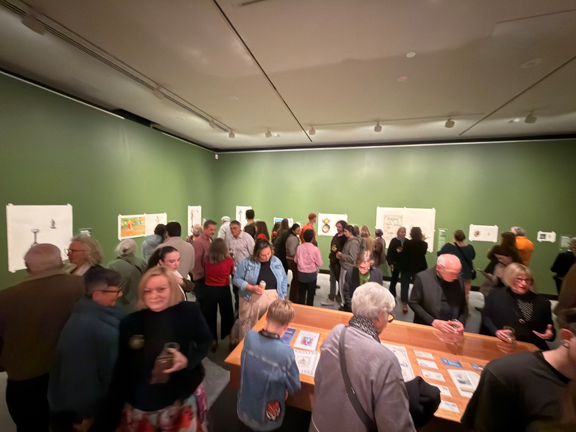
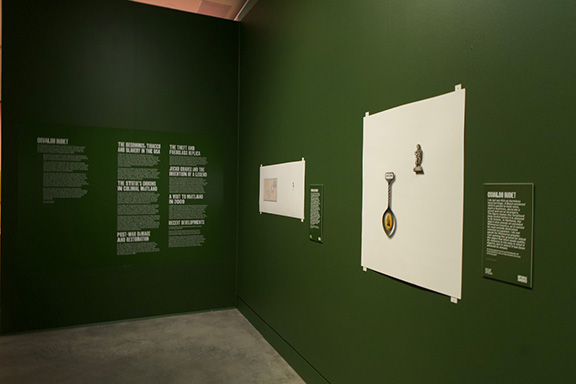
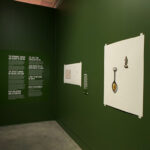
My exhibition, presented as part of UPRIVER DOWNRIVER, brings together drawings, photographs, historical images, texts and archival documents. The works have long titles, engaging with strategies of conceptual art and the practice of artists such as Hans Haacke, for whom information, language and research also form part of the artistic material.
I did not intend to offer a neutral interpretation. Contemporary art is not required to pretend neutrality in the face of power. My work investigates how images produce ideology, how they circulate within institutions, and how some memories are turned into heritage while others are discarded, silenced or deliberately forgotten.
On 13 July 2026, I added to the installation a heritage report commissioned by Maitland City Council about the hitching post. It was a public document, funded with public money and directly related to my research.
Two days later, the report was removed from the exhibition without my knowledge or consent.
The gesture was revealing. Council did not merely attempt to control the interpretation of the object in public space. It physically intervened in an artwork analysing precisely how institutions control memory.
After I challenged the decision, the document was returned. However, reinstating material after a protest does not erase the original act of censorship. The integrity of an artwork should not depend on permission from the very institution being examined by that work.
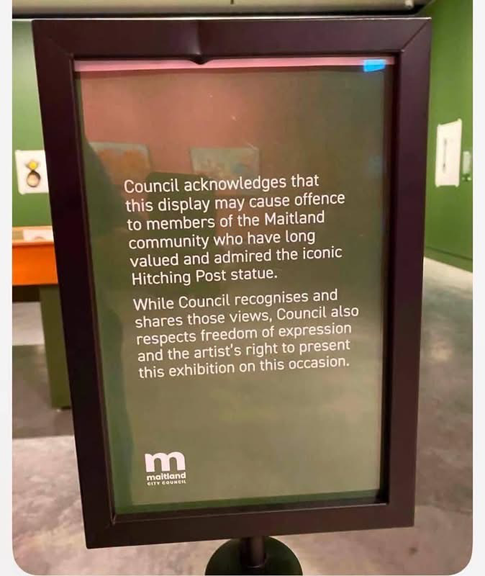
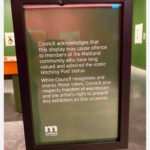
Council also installed a sign beside the exhibition. It reads, and I quote:
“Council acknowledges that this display may cause offence to members of the Maitland community who have long valued and admired the iconic Hitching Post statue.
While Council recognises and shares those views, Council also respects freedom of expression and the artist’s right to present this exhibition on this occasion.”
That sentence turned freedom of expression into a temporary concession granted by municipal power.
The racist object remains normalised in the city. The work investigating it is the one that requires a warning, which remains installed to this day.
Mayor Philip Penfold later introduced a council motion describing my exhibition as primarily a political statement rather than art. He also defended the figure’s continued presence and referred to me as an out-of-towner.
The opposition between art and politics is false. Art is always situated within material relations: institutions, money, property, labour, class, race and power. Declaring that a work ceases to be art because it questions a political structure is a strategy for delegitimising it.
My exhibition never demanded the removal of the figure. Nevertheless, the debate was reduced to a convenient question: “Should it stay or disappear?” That simplification made it possible to avoid other questions: Who authorised the removal of material from an artwork? Why did Council intervene in a public exhibition? What interests were being protected?
The use of the expression out-of-towner also sought to present the city as the cultural property of those who already control its narrative. But Maitland stands on unceded Wonnarua Country. Using local belonging to silence a discussion about colonialism is a historical contradiction.
The support of Mindaribba Local Aboriginal Land Council was fundamental. Its solidarity reminded us that the object does not exist only within American racial history. It is also installed within an Australian colonial landscape.
Anti-Black racism and settler colonialism are not identical processes, but they share a material logic: turning territories, bodies, and histories into property. Both systems determine who may speak, who may belong, and which memories deserve protection.
While Council defended the nostalgia of those who loved the figure, Mindaribba recognised the right of racialised communities to name the harm.
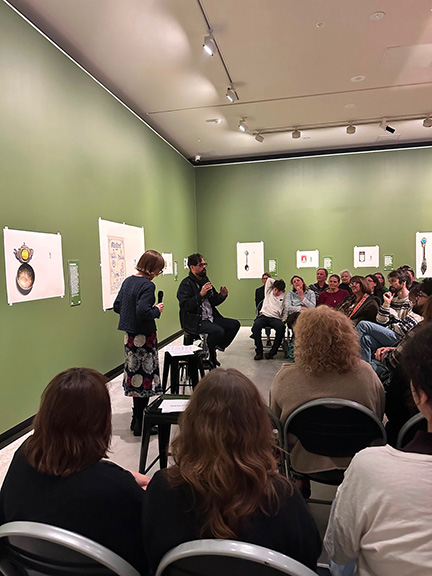
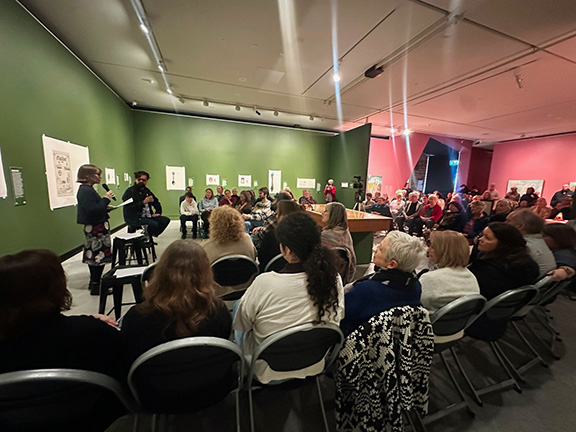
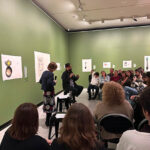
More than 120 people attended my public conversation at the gallery, even though the gallery was under a gag order preventing it from mentioning or promoting my talk. The response demonstrated that the community did not need to be protected from the debate.
On 26 July, I published an Open Letter to the Maitland Community. That same day, I sent a formal complaint to Council’s General Manager, copying the Mayor, every councillor, Mindaribba Local Aboriginal Land Council, and Maitland Regional Art Gallery. The following day, I sent the letter by registered post.
I requested the removal of the sign, an explanation of who authorised the intervention, a correction of the public record, and guarantees that my work would not be altered again without my consent.
The controversy was no longer solely about a figure. It was about the artist’s moral rights, the autonomy of cultural institutions, and the use of political power to control a historical narrative.
As a Puerto Rican, I recognise this operation. Colonialism does not live only in laws and armies. It also lives in monuments, museums, archives,traveled and seemingly innocent stories.
An image produced by American racial capitalism traveled to Australia, where it was transformed into heritage. When a Boricua artist exposed it’s genealogy, the local government intervened to protect the stability of its meaning.
That journey is the artwork.
The Maitland figure shows that commodities do not travel alone. They travel with the relations of exploitation that produced them, even when a society attempts to cover them with paint, nostalgia, and affection.
Historical truth does not destroy a community. What it threatens is the unequal distribution of power: who controls memory, who defines heritage, and who must remain silent so that others can continue to feel comfortable.
Truth is not division.
Censorship is.
Photos by the author.