



A severe energy crisis in Cuba has worsened sharply since the start of 2026 as a result of the measures taken by the United States against the island’s communist government. Many Cubans are facing extreme hardships due to a lack of basic necessities and are hoping for change.

Photo by Jean-Michel Hauteville | Centro de Periodismo Investigativo
| Originally p
Sitting on a bench in Trillo Park, one of the few green spaces in Cayo Hueso, a working-class neighborhood of central Havana, Humberto García and his wife Marlene Rodríguez were chatting and enjoying beers while watching their grandchildren play nearby, in the fading daylight of a balmy Thursday afternoon. But in Cuba, such a scene of simple joy may not tell the whole story.
“We’re hungry. We have many needs”, grumbled García, his good spirits evaporating as he told Centro de Periodismo Investigativo in April about daily life in his district of Centro Habana, one of the fifteen municipalities of the Cuban capital. “It’s my birthday, so a neighbor gave us these two cans,” said the man, who was turning 59 the next day. A house painter, García said he had been out of work for several weeks after many construction sites across the city had halted due to a shortage of building materials.
“We can’t even afford eggs,” he complained, adding that his breakfasts consisted of “water with sugar and some bread.”
What was an already dire situation in Cuba has worsened over the past year as the Trump administration imposed new rounds of sanctions on the country’s officials and leading institutions, intensifying six decades of economic embargo. The measures were aimed at bringing down the island’s communist government, but they have instead deepened the pressure on ordinary Cubans. An oil blockade enforced after a Jan. 29 executive order by Trump — just weeks after a U.S. military operation in Caracas removed Venezuela’s head of state, Nicolás Maduro, a key ally of Havana — has caused an unprecedented fuel shortage.
That pressure mounted further on May 17, when French shipping giant CMA CGM and its German rival Hapag-Lloyd suspended services to Cuba “until further notice” to comply with a new White House executive order issued May 1. Airlines, hotel chains, credit card companies and payment services followed in subsequent weeks, delivering another blow to the country’s battered economy.
The consequences have been immediate. On July 6, Cuba suffered another widespread blackout — the third in six months and the eighth since late 2024 — after a “total disconnection” of the power system affected the entire island. The outage underscored how the crisis has moved beyond the energy sector, disrupting work, food distribution, access to medicine and daily life across the country.
Life in the Dark
Darkness gradually shrouded Trillo Park and the surrounding buildings as dusk fell, yet most windows remained unlit — that Thursday evening, much of Havana was once again left without power. Blackouts have been common in recent years in Cuba, due to the outdated and poorly maintained electrical grid – partly as a result of the US embargo. Since the start of the oil blockade, Cuba has suffered two more island-wide blackouts in March and several significant outages affecting entire regions.

Photo by Jean-Michel Hauteville | Centro de Periodismo Investigativo
“We eat in the dark, by candlelight,” García asserted. “And so we just hang out in the park since it’s too dark inside,” he said. “Not to mention the mosquitoes,” Rodríguez added. Although the seamstress audibly agreed with most of her husband’s statements, she also urged him, more than once during his rant, to keep his voice down. At one point, the couple recognized the silhouette of a younger woman walking towards them in the twilight: a neighbor who works for the Police, they said. They changed the topic altogether and waited for her to be well out of earshot to get back to the conversation.
And yet, according to many Havana residents, the apagones or blackouts were less frequent and shorter during a few weeks in April, after a Russian oil tanker docked at Matanzas harbor on March 31, marking the first fuel delivery to the island in more than three months. The 100,000 tonnes of crude oil it carried offered some much-needed relief to the besieged country. But not everywhere. Outside the capital, life without electricity remained the norm. “My relatives in Baracoa get two hours of electricity a day, at most,” said a taxi driver in his thirties, referring to his hometown in Guantánamo province. Like many Cubans interviewed for this story, he spoke on the condition of anonymity.
The reprieve only lasted for about a month. On May 13, Vicente de la O Levy, the minister of Energy and Mines, announced in a televised statement that the country had “absolutely no fuel oil, absolutely no diesel” left, and the oil reserves had run out. The only resources available, he added, were associated gas from domestic wells and domestically produced crude oil, whose extraction was insufficient to sustain the power grid despite increased output.
Two days later, the retail price of gasoline was doubled overnight to a whopping $2.60 per liter at state-owned gas stations.
However, these official prices mean little to average Cubans. “Most gas stations are empty!”, scoffed the young taxi driver while steering his green 1957 Ford on the highway between Havana and the town of Santiago de Las Vegas, in the outskirts. “These days, your best bet for finding fuel is the roadside vendors,” the thirty-something said bitterly. On the black market, one liter of gasoline could cost up to 5,000 pesos cubanos, or nearly $10.00 at the unofficial exchange rate, which Cubans check online on a daily basis for their everyday transactions.
Few people can afford such high gas prices anywhere, much less in Cuba. According to official data released in April, the average monthly salary of working Cubans was just about 6,900 pesos in 2025 (about $13.00). That’s slightly more than the price of two crates of 30 eggs – a benchmark often used by locals to put their salaries into perspective.
“For example, take a bag of ten pounds of frozen chicken. That costs 4,900 pesos, which is pretty much what I make every month,” said a 61-year-old from the residential neighborhood of El Vedado, who asked for his identity to be protected.
In theory, Cubans can purchase food at subsidized prices thanks to the “supply booklet” (la libreta de abastecimiento) provided by the government to each household, but in recent years, the state-run bodegas have been running out of food to sell, so many Cubans have to buy food in private stores for a much higher price.
The father of four, who works as a chauffeur for a senior civil servant, whipped his phone out of his pocket, opened the calculator app, and divided his monthly pay by 520 to get the equivalent in dollars: just about $10. By late June, high inflation had driven the exchange rate to 680 pesos per dollar, while the official exchange rate of 24 pesos per dollar had remained unchanged.
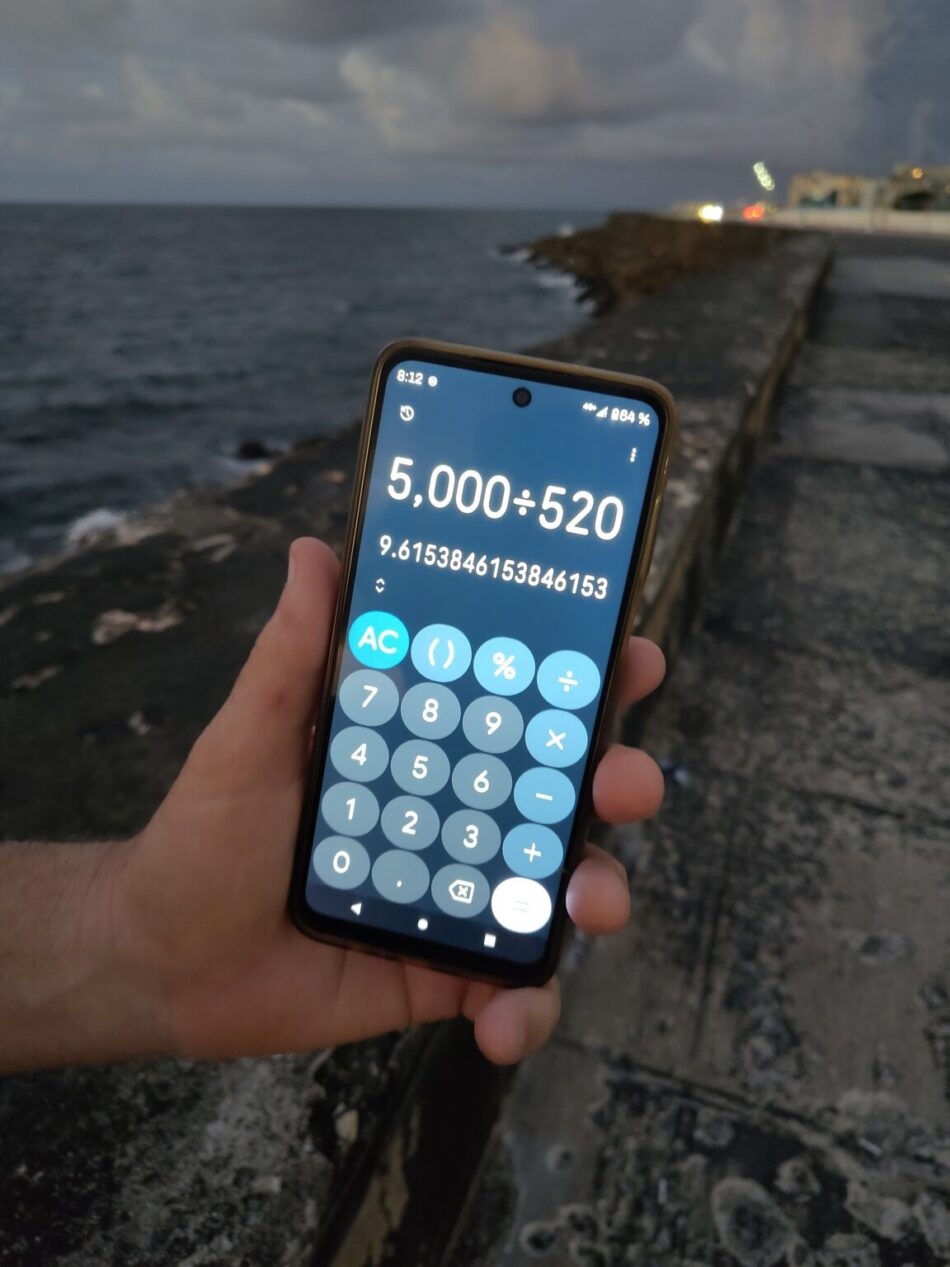
Photo by Jean-Michel Hauteville | Centro de Periodismo Investigativo
Yet, the man, accompanied by his wife while spending some time on the Malecón in Havana, seemed rather undaunted by the hardships.
“We get by thanks to our son who works in the US; he sends us money every month,” he said. The 37-year-old, who left Cuba on a scholarship as an engineering student years ago and stayed in the US after he graduated, helped his parents purchase an energy storage battery for $800, which charges when the grid is working. “So we can turn on the lights, the fan and the fridge during the blackouts,” he added.
Like this couple, most Havana residents somehow manage to just get by, one day at a time. In many cases, remittances from relatives abroad are their lifeline. Many avoid being too specific about their daily struggle to survive. Instead, they simply come up with “inventando” — “inventing” or devising creative solutions to the dire situation. This phrase encapsulates how resourceful one needs to be just in order to eat at least one meal per day.
“We sell things that we have in order to be able to buy what we need,” shrugged a 25-year-old actress who was enjoying an afternoon chat in a public playground on Calzada Street, in El Vedado, with her grandmother, her aunt and her two young daughters. “We can’t keep anything in the fridge because of the power outages, so we have to buy groceries day by day,” her 80-year-old grandmother complained. “We do manage to have enough to eat, but there are many people living in poverty. It’s heartbreaking,” the octogenarian said. The remittances from her son, who lives in Florida, help her survive, “but it’s not pleasant to have to live like this,” she sighed.
Poverty has indeed become pervasive in Havana. The sight of people rummaging through rubbish in hopes of finding something edible or valuable is now common in the capital. “There’s crime, theft, violence now. We didn’t use to have things like that,” said García, the disgruntled grandfather in Trillo Park. A report by the Cuban Observatory of Citizen Audit has confirmed a notable rise in crime since 2025 through social media monitoring, as official data is not available.
For the many Catholic and Protestant churches and charitable organizations that have long provided support to people in need, this task has become more daunting amid the worsening crisis. “There have always been people living on the streets. But there are more and more of them,” asserted Innaris Suárez Cárdenas, the director of the Sant’Egidio Community in Havana, established in 1992 by an international faith-based organization founded in Rome. “The Cuban government has long denied this reality, but it can no longer do so,” the volunteer worker noted.
Every Monday and Friday, in the late afternoon, a team of Sant’Egidio members walks down nearby streets to distribute food to the homeless.
“Good afternoon! Would you like a snack?” Claudia Alonso Betancourt asked, again and again, to the disheveled people she met around Compostela Street and San Juan de Dios Park, one late Monday afternoon. Always with a warm smile and a few words of comfort. That time, the team consisted of only three people, but in less than an hour, dozens of sandwiches — simple round rolls, previously spread with mayonnaise in the Community’s kitchen — and cups of strawberry yogurt drink were given away. “That’s all we could get today,” said Alonso Betancourt, sounding both resigned but unshakably optimistic. “We make do with whatever we can get.”
And twice a week at midday, the charity opens the doors of its headquarters in the municipality of Habana Vieja to elderly residents for a free lunch cooked and served by volunteers. That soup kitchen started operating about a year and a half ago, and “mostly elderly people from this neighborhood come. Because, of course, getting around several times a week has gotten more difficult,” Alonso Betancourt said. “They eat well — as balanced a meal as we can provide with the resources we have, of course — and 120, sometimes 150 elderly people come to eat,” the woman in her thirties added, pointing out that the Community wants to “ensure they have a sense of dignity.”

Photo by Jean-Michel Hauteville | Centro de Periodismo Investigativo
Running a charity like this has become more challenging as Cuba’s downward spiral goes on. “The fuel problem has affected many volunteers’ attendance. There used to be more people coming; now there are fewer,” lamented Suárez Cárdenas. The Sant’Egidio Community used to arrange transportation for its members requiring it, but this is no longer possible, the group leader said. And since the organization runs operations in various neighborhoods of Havana, “everything we do requires mobility: going to pick up food, the people who donate things to us, going to pick it up, sometimes transporting people,” she added.
There is “profound social exhaustion” and a “sense of hopelessness” in Cuba as a result of the hardships, summarized María José Espinosa Carrillo, a non-resident fellow at the Center for International Policy and the Executive Director of the Washington-based Center for Engagement and Advocacy in the Americas (CEDA).
However, “the crisis that we see today in Cuba is the product of the interaction between domestic policy choices but also external constraints,” the Cuban-born expert said. The Cuban government “bears a significant responsibility for the current situation,” Espinosa Carrillo stated.
Specifically, the energy crisis is not just the result of the oil blockade, but also of “years of underinvestment, aging infrastructure, delayed modernization that really left the current system vulnerable,” the CEDA director said.
“Over the last decade, the government allocated substantial resources to high-end hotel construction while underinvesting in power generation, transmission, and grid maintenance,” said Ricardo Torres Pérez, a research fellow and adjunct professor at the Center for Latin American and Latino Studies at American University in Washington, D.C.
The shortage of funds and spare parts caused by the embargo “is real, but it is also the result of long-standing policy choices. On top of that, US sanctions increase the financial costs of trade transactions as banks deal with the risk associated with Cuba,” Torres Pérez added.
“So when you have an external shock, as is the second Trump term, the system has very little resilience left,” Espinosa Carrillo concluded.
In response, Cuban authorities have approved a package of 176 economic measures that amount to an emergency effort to loosen parts of the economy without formally abandoning socialism. The reforms would expand the role of the private sector, ease access to foreign currency, authorize private banking operations under state supervision, allow Cubans living abroad to invest directly on the island and review universal subsidies with the goal of gradually replacing them with targeted assistance for vulnerable people.
A public health crisis
The lack of fuel has severely hampered waste collection for months, although trash heaps had begun popping up throughout the city long before the oil blockade. In Centro Habana, just opposite the elegant red building where Centro Loyola Reina — another Catholic organization that focuses on social and educational activities — has established its headquarters, a pile of rubbish blocked the entire sidewalk on División Street for several days in April. “It attracts pests — mosquitoes and flies. The flies make it all the way up to the third floor, because the whole tree is infested with them,” said a clearly frustrated Glorianna Rodríguez Chávez. The young psychologist runs Proyecto Otoño, a group that organizes workshops for seniors at Centro Loyola Reina.

Photo by Jean-Michel Hauteville | Centro de Periodismo Investigativo
Earlier this year, Cuban media announced that authorities had identified 122 “temporary collection sites for solid waste” across Havana’s fifteen municipalities, including 24 sites designated for “controlled incineration”. The situation was more critical in the central districts of the Cuban capital, which have “high population density and large amounts of solid waste,” deputy Havana governor Reynol García Moreira was quoted as saying in February.
Months later, however, the waste crisis still seemed far from under control. The unsanitary conditions were blamed for the spread of mosquito-borne illnesses such as chikungunya fever, dengue fever and the Oropouche virus disease. The outbreaks peaked during the rainy season at the end of last year. “And almost all of our staff members were sick, bedridden, aching and swollen. Almost all of the seniors were sick too,” Rodríguez Chávez recalled. By late December, health authorities had officially recorded nearly 48,000 cases of dengue or chikungunya and 55 deaths. More than half the fatalities were children. The cooler, drier weather in early 2026 kept the mosquitoes in check and, in turn, the epidemics were finally contained. But with another rainy season starting, Proyecto Otoño staff were asked to “take precautions such as wearing pants, wearing long-sleeved shirts” to avoid mosquito bites, the group coordinator noted.
Cuba’s health crisis could further deteriorate, however, because the country has “a population with a severely inadequate diet,” remarked Yenia Pupo, the head of the educational program at the Christian Center for Reflection and Dialogue in Cárdenas, a town in northern Cuba. The psychologist explained that she has seen villages “where children go all day without breakfast or a snack, surviving on just a little rice, some soup, a broth, and a sweet potato.” With such poor nutrition, “even a minor illness — a cold — can turn into something serious,” Pupo warned.
To make things worse, the country has been experiencing an even more acute shortage of essential medicines, which primarily affects Cubans with chronic diseases. Pharmacies “don’t have blood pressure medications, they don’t have diabetes medications, they don’t have medications for thyroid conditions. And you can’t even find a painkiller at the pharmacy anymore”, Pupo lamented.
As a result, patients who cannot get their medication delivered by acquaintances traveling from overseas have no other solution than black market vendors, but with a steep markup. For instance, a key medication for high blood pressure “used to cost around 15 pesos ($0.02) at Cuban pharmacies. A blister pack of 10 tablets on the black market costs 350 pesos ($0.60),” the psychologist from Cárdenas said. Many patients are simply priced out of getting treatment. “The healthcare situation is truly dire, especially in a country where public health was always considered among the best in the region, with elite professionals and truly excellent care for the population,” she said.
“We need change”
The multiple crises affecting Cuba have been severely disrupting education as well. “We’ve had remote classes for two months now,” said an information and technology student at José Antonio Echeverría Technological University (CUJAE) who wished to remain anonymous. “But sometimes, there are power outages at the university, so there are no classes at all. Or sometimes, it’s the students who can’t log on because we have no electricity and no internet connection,” grumbled the young man, who was walking down the wide, leafy Paseo Avenue with three friends on an early Saturday evening.
“Education in Cuba is at risk due to the current energy crisis,” alerted Anne Lemaistre, the UNESCO regional office director in Havana, in a social media post on May 29. Students and teachers struggle to attend school and learn effectively, she denounced. “It jeopardizes the future of an entire generation, with long-term consequences,” the UN official wrote.
That Saturday evening, however, the CUJAE students were having a good time: the four friends, all in stylish, vintage outfits, had just gotten out of the Teatro Nacional, where they had enjoyed a ballet for 150 pesos ($0.28). How did they manage to take care of their looks like that? “Inventando,” once again.
On the Malecón, the chauffeur and his wife were highly critical of the aggressive foreign policy pursued by the Trump administration. “We need change, but not at any cost,” said the 61-year-old. “The Americans bombed a school in Iran: are they going to do the same thing here?”, he asked. “Sixty-eight years after the revolution, it’s time for change”, echoed a night watchman who took pride in being born the year when the Cuban revolution prevailed. That change, however, “has to come from us, the Cubans,” added the man, who chose to keep working even though he is eligible for retirement, given how meager the pensions are.

Photo by Jean-Michel Hauteville | Centro de Periodismo Investigativo
Other Cubans, especially the younger ones, who grew up in a country in perpetual crisis, are more forceful in their rejection of their government. “I’m waiting for Trump to come and do what he did to Maduro,” blurted out the young actress sitting in the public park on Calzada Street with her grandmother. “Or else, let the whole country take the streets: there aren’t more of them than there are of us,” said the mother-of-two with a defiant tone.
New waves of nocturnal protests started in various parts of Havana and other Cuban cities in mid-May, after Russian oil supplies were depleted, worsening blackouts. Some desperate residents of the Cuban capital demonstrated outside and lit fires in the streets as a sign of discontent, while frustrated citizens had resorted to banging pots and pans from their windows.
“People aren’t going to stop protesting if there’s no solution. And it’s clear that the government doesn’t have any kind of solution—it just tells people to ‘resist’,” commented Laritza Diversent, the executive director of Cubalex, an organization of Cuban lawyers and human-rights advocates based outside the island.
“People need to vent their frustration, to get out of the frustration of not having water, of not having this or that,” said the lawyer who lives in the United States after being granted political asylum there.
In an interview published by the Puerto Rican digital outlet Claridad, Cuban President Miguel Díaz-Canel was asked about the pot-banging protests that have been reported almost every night in some parts of the country as frustration grows over the blackouts. “People bang pots, some with more displeasure than others,” the president replied. But he attributed the crisis to the U.S. blockade: “Bang your pots at the neighbors to the north,” he said.
The Cuban president nevertheless acknowledged the extent of the social unrest caused by the crisis. “Things have to be done, and we cannot remain stuck in time. I tell them that, amid this whole situation (…) which is difficult — because here there are shortages of transportation, food, and medicine, and prolonged blackouts of more than 20 hours — this creates dissatisfaction; no one can be happy; the people are suffering. It is part of the imperialist strategy. The imperialist strategy is to suffocate us economically in order to provoke that: a rupture between the people and the Revolution,’” Díaz-Canel said.
Still, he argued that the crisis should not be read simplistically. “These are not issues to be seen in black and white; they involve many situations, many reasons. But, look, I am convinced that we are going to overcome this, that we are going to move forward, that we are going to prevail, and that we are not going to surrender,” he said.

Photo by Jean-Michel Hauteville | Centro de Periodismo Investigativo
At a queer bar on Línea Avenue — one of those unexpectedly trendy spots that still lends a semblance of normality to life in the Cuban capital — Daniel Triana, a 28-year-old artist and educator, did not mince his words.
“A dictatorship of this kind — this Soviet-style, anachronistic, and outdated system — has no place in the 21st century,” argued this prominent figure in Havana’s LGBTQ community, who contended that he had been arrested, despite his fame, “about ten times” since 2019 because of his political views. The naval blockade “undeniably has a negative impact on the lives of ordinary Cubans,” the young theater actor lamented. Nevertheless, “if the Cuban government — as seems to be happening — negotiates, reaches agreements, and de facto begins a political transition, then the sanctions will have been a positive thing. Only time will tell,” said Triana, who wants to emigrate.
“The United States wants to bring about changes in Cuba, but it seems to want to achieve that through negotiation” while “pressuring” the island through the oil blockade, said Alejandro Rosés Pérez, a researcher at the Havana-based Center for International Policy Research. In his opinion, although a US military intervention seems much less far-fetched than a few years ago, it remains unlikely as the US government seems focused on “changes on the economic front” on the island. “I see no signs indicating that Cuba and the United States are negotiating fundamental changes to Cuba’s political system,” said Rosés Pérez.
With the Iran conflict far from resolved, many believe that Cuba would be the United States’ next target. “The standoff in which both countries are right now is very dangerous,” said Espinosa Carrillo, the CEDA executive director. Over the next few weeks, we will see “a couple of scenarios moving at once,” she predicted. As the sanctions keep strangulating the island’s economy, “Cuba could see unrest this summer,” but “the military and party apparatus are going to resist concessions that could threaten them,” she anticipated. “At the end of the day, what’s important is that ordinary Cubans are absorbing the consequences and the risk of societal collapse,” Espinosa Carrillo warned, adding that the consequences of a humanitarian disaster in Cuba “could have impacts on Caribbean islands, on Latin American countries and also on the US.”
Ordinary Cubans keep “inventing” to stay alive and sane. Local Christian organizations hope they can keep making miracles happen. “The crisis is so severe, food is so expensive, and the number of poor people is growing. Yet, in 2025, we managed to put together a Christmas feast for 2,000 people,” recounted Alonso Betancourt, the Sant’Egidio Community volunteer.

Photo Jean-Michel Hauteville | Centro de Periodismo Investigativo
In a large room with a stage inside Centro Loyola Reina, half a dozen women in their sixties, seventies and eighties rehearse a play with their drama instructor, Yoamaris Neptuno Domínguez, as part of the Proyecto Otoño activities for seniors. The theater workshop has been running twice weekly for months, despite fuel shortages and other hardships that kept many members from attending, as well as power outages that disrupted some sessions. About half the members were missing that Monday morning. A 61-year-old woman said she had to walk for 40 minutes to get to drama class.
“When there’s no electricity, we open the window. And that’s what we call a Cuban-style rehearsal,” joked one grandmother, who said that “they perform plays with flashlights” in theaters across the country during blackouts. “That’s just how we Cubans are. We have this trait where whatever test life throws at us, we just keep moving forward,” one of her friends chimed in. “We’re invincible.”